
How to Take Notes That Help You Learn Faster and Better
- How to Take Notes That Help You Learn Faster and Better
- Key Takeaways
- Why Good Notes Improve Class Learning
- How to Prepare for Class Note Taking
- Preview Class Materials
- Review Syllabus And Prior Notes
- Organize Notes By Class
- What to Write Down During a Lecture
- Best Note-Taking Methods by Class Type
- Lecture-Heavy Classes
- Data-Rich Classes
- Discussion-Based Classes
- How to Review Class Notes So They Stick
- Where to Get Help With Note Taking
To take notes that help you learn faster, focus on main ideas, key words, and important examples during class. Use a neat format, like outlines or Cornell notes, and leave space for extra details. Read your notes within 24 hours and test yourself by recalling them from memory. Fix any gaps and write questions in your own words. If you keep going, you’ll pick up even more smart note-taking tricks.
Key Takeaways
- Capture main ideas, keywords, and “to sum up” moments during class to keep pace and understand the lesson structure.
- Prepare with skim reading, syllabus review, and preview materials so you know what matters before class begins.
- Use a note format that fits the class, such as outlines, Cornell notes, concept maps, or charting for data-heavy topics.
- Leave space for questions and confusing points, then review and fill gaps within 24 to 36 hours.
- Practice active recall by closing your notes, writing what you remember, and explaining ideas in your own words.
Why Good Notes Improve Class Learning
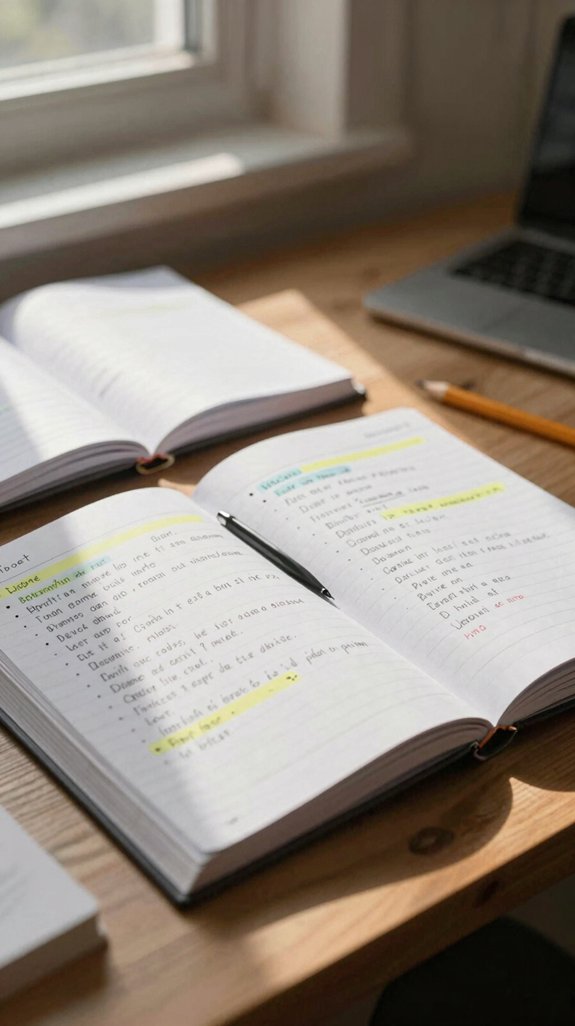
Good notes can make class feel much easier to follow. You stay alert, listen more closely, and catch main ideas as they happen.
That helps you feel like you belong in the lesson instead of falling behind.
When you use critical listening and concept mapping, you organize what you hear into clear connections.
Writing by hand can also help your brain hold information better.
After class, your notes support active recall and spaced repetition, so review feels easier.
Since you can forget lots fast, good notes give you a steady path back to the lesson.
How to Prepare for Class Note Taking
Before class, skim the reading so you can spot big ideas and key words.
Check the syllabus and your last notes so you know what matters most and where new ideas fit.
Keep each class’s notes neat and dated so you can find them fast later.
Preview Class Materials
To get ready for class notes, preview your materials first.
Skim readings and course slides, and look for main ideas.
Check what each class covers so you know what matters most.
Then glance at last class’s notes to fit new ideas in order.
If your class uses video and discussion, mark the parts you should watch closely.
This helps you listen better and ask stronger class questions.
You’ll feel more ready, like you belong in the room.
- Open the reading like a map
- Circle big ideas and key terms
- Mark video spots with tiny stars
- Stack notes in date order
- Leave space for active listening
Review Syllabus And Prior Notes
Your syllabus and old notes can act like a study map. Before class, scan the syllabus for big topics and must-read pages. Then glance at your last notes to see where today fits. That helps you catch the right ideas fast.
| Check | Why it helps |
|---|---|
| Syllabus | Shows what matters most |
| Readings | Points to main ideas |
| Old notes | Connects new lessons |
| Predictions | Guides your note-taking |
| Questions | Sparks class reflections |
Bring those ideas to study groups, peer questions, and critique sessions. You’ll feel part of the class path, not lost in it.
Organize Notes By Class
Now that you know how to read the syllabus and old notes, it’s time to set up your class notes the smart way.
Check each syllabus before class so you know the main topic.
Peek at readings too, and mark big ideas.
Then, review the last session so new notes fit in order.
Make a title page for each class and keep pages dated.
Use separate sections or notebooks, and file everything chronologically.
That helps your group feel ready for peer led learning and group note sharing.
- Topic title
- Reading clues
- Last lesson
- Class section
- Date line
What to Write Down During a Lecture
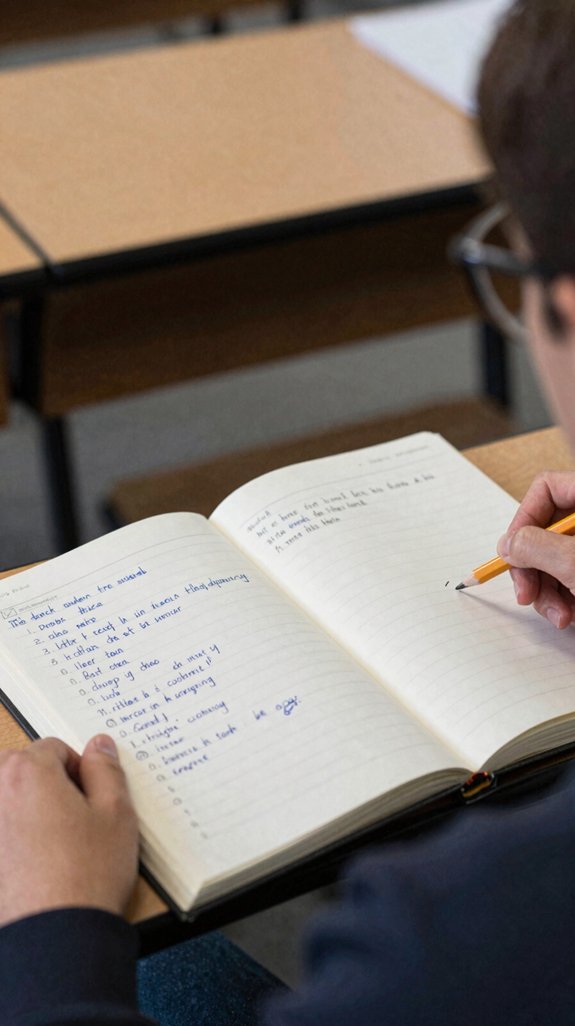
While you listen to a lecture, focus on the big ideas first. Use active listening to catch the main points and the talk’s shape. Write keywords, dates, names, and key definitions. If the teacher says “To sum up,” stop and note it. Mark any question prompts or confusing ideas right away. Jot important lines that may show up on tests, then review them within 24 hours. Watch for pauses, pointing, and strong voice changes. Those are importance markers. For peer study sessions, this helps you explain the lesson.
| What | Do | Why |
|---|---|---|
| Main points | Write them | See the structure |
| Verbatim lines | Copy key facts | Boost recall |
| Cues | Mark them | Spot importance |
Best Note-Taking Methods by Class Type
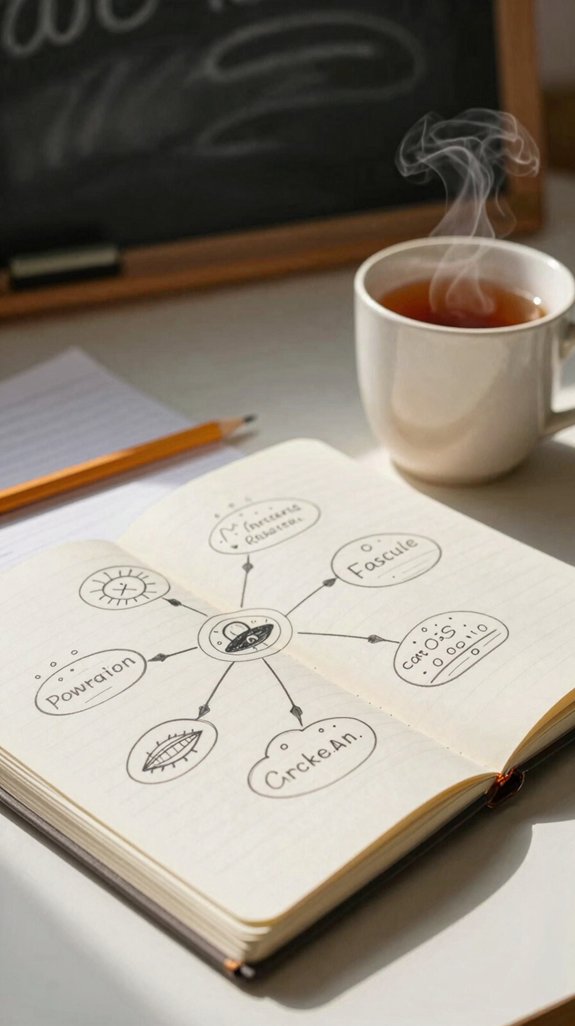
The best note-taking method depends on the kind of class you’re in.
For lecture-heavy classes, an outline keeps ideas neat and easy to study.
For data-rich or discussion-based classes, charting, mapping, or sentence notes can help you catch what matters most.
Lecture-Heavy Classes
In a lecture-heavy class, your notes need to catch the lesson’s shape, not just the words. Use active listening to spot main ideas, then write them in an outline.
If you’ll do peer Q&A or key concept recall after class, try Cornell Notes.
For fuzzy ideas, add a visual explanation with a concept map.
Choose handwritten notes for memory, or digital notes for speed.
Don’t type every word; pick the big points that help you belong in the class discussion.
- Main idea on the left
- Indented details below
- Cue words ready to quiz
- Branches for linked ideas
- Short, clear lines
Data-Rich Classes
When your class is full of numbers, charts, and comparisons, your notes should be just as organized.
Use the Charting Method by making category headings before class. Then place key words and facts in the right column. This helps you compare ideas fast and build clean study sheets.
For fast science or math talks, preview the reading first and catch the main facts.
If ideas connect closely, try a simple map to show links.
In peer teaching circles, share study group summaries.
Review your chart or map within 24 to 36 hours, and use active recall to lock it in.
Discussion-Based Classes
Discussion-based classes can feel like a fast-moving conversation, so your notes need to stay flexible.
For class prep, use Cornell notes or an outline so you can catch main claims and cue words from the video.
During class, follow the discussion focus and write questions when ideas feel fuzzy.
- Draw a web when themes connect
- Use a chart for side-by-side debates
- Try one numbered line for each idea
- Circle facts that sound important
- Leave space to add after class
This keeps you with the group and ready for a strong review later.
How to Review Class Notes So They Stick
To make your class notes really stick, you need to look them over soon after class.
Review them within 24 to 36 hours for about 30 minutes.
First, do five minutes of active recall.
Close your notes and write what you remember.
Then check the gaps and fix them.
Next, write questions and explain ideas in your own words.
That helps you retrieve facts, not just reread them.
After that, add missing details and chunk topics into neat groups.
Make a quick study guide or flashcards, and test yourself.
Peer feedback, group recap, memory mapping, and error checking can help too.
Where to Get Help With Note Taking
If note taking feels tricky, you don’t have to figure it out alone. You can ask your instructor during office hours or meet a TA.
A coach can help you with your notes one-on-one. The Learning Center also offers handouts and videos.
Try Cornell cues/notes/summary, then ask for feedback.
In study group interaction, your friends can share peer feedback techniques that make your pages clearer.
- a quiet desk with open notebooks
- a friendly office hour chat
- a coach pointing to your plan
- a video on a bright screen
- a study group circling ideas
Review your notes within 24–36 hours for 30 minutes.