Space Activities for Kids That Make Learning Fun and Interactive
- Space Activities for Kids That Make Learning Fun and Interactive
- Key Takeaways
- Space Activities That Teach Science
- Build a Balloon-Powered Space Rover
- Launch Paper Straw Rockets
- Rocket Craft Materials
- Building Straw Launchers
- Launching Flight Tests
- Make a Touchable Solar System
- Build Textured Planet Models
- Explore Orbits With Touch
- Try a Moon Crater Experiment
- Create Yarn-Wrapped Planets
- Play Planet Games
- Map Constellations With Geoboards
- Set Up a Space Sensory Bin
- Space-Themed Fillers
- Sensory Play Ideas
- Vocabulary Through Exploration
- Make a Galaxy in a Jar
- Craft an Astronaut Training Center
- Turn Space Projects Into STEM Lessons
You can make space science exciting with hands-on projects that let you investigate and test ideas. Build a balloon-powered rover, launch paper straw rockets, or drop rocks into flour to study moon craters. You can also make a touchable solar system, sort items in a space sensory bin, or swirl a galaxy in a jar. Each activity helps you learn science while you play, and the next ones may surprise you.
Key Takeaways
- Crater experiments let kids drop rocks into flour-and-cocoa “moon soil” to compare impact energy and crater size.
- Balloon-powered rovers and straw rockets teach propulsion by testing distance, speed, direction, and launch force.
- Touchable planet models, orbit games, and constellation builds make solar system concepts hands-on and memorable.
- Space sensory bins with planets, astronauts, and mixed textures build vocabulary through sorting, digging, and play.
- Creative crafts like galaxy jars and astronaut training centers add storytelling, missions, and STEM challenges.
Space Activities That Teach Science
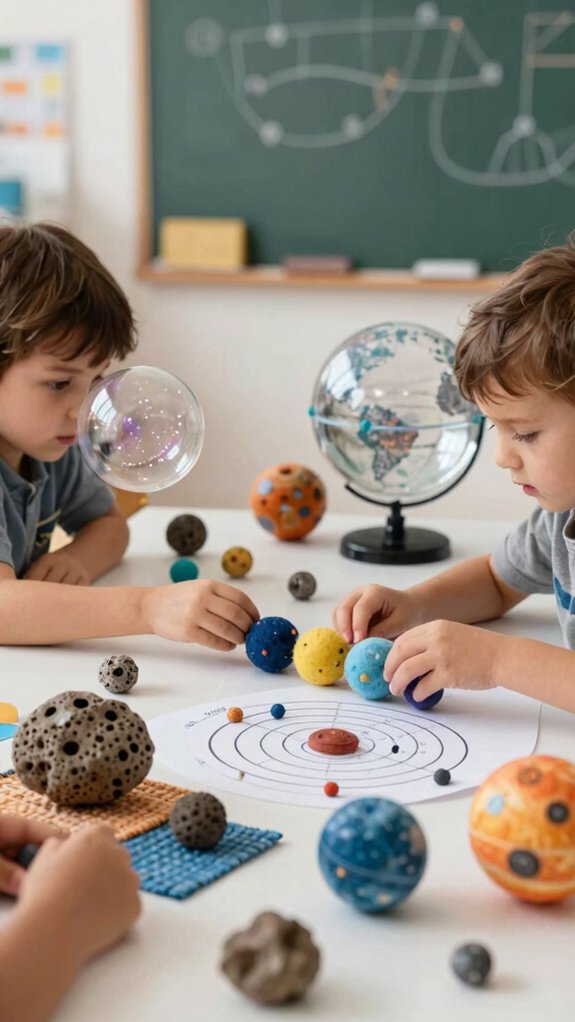
If you want to learn science, space activities can make it feel exciting and real.
You can join in with a Moon crater experiment and see crater impact effects in action.
Drop small rocks into flour and oil, then compare the crater shapes.
You can also test a Venus greenhouse idea with vinegar, baking soda, and a candle.
That shows how carbon dioxide shapes Venus’s thick air.
These hands-on tasks help you think like a scientist.
You’ll notice changes, ask questions, and feel part of a curious space crew.
Space science gets easier when you investigate with your own hands.
Build a Balloon-Powered Space Rover
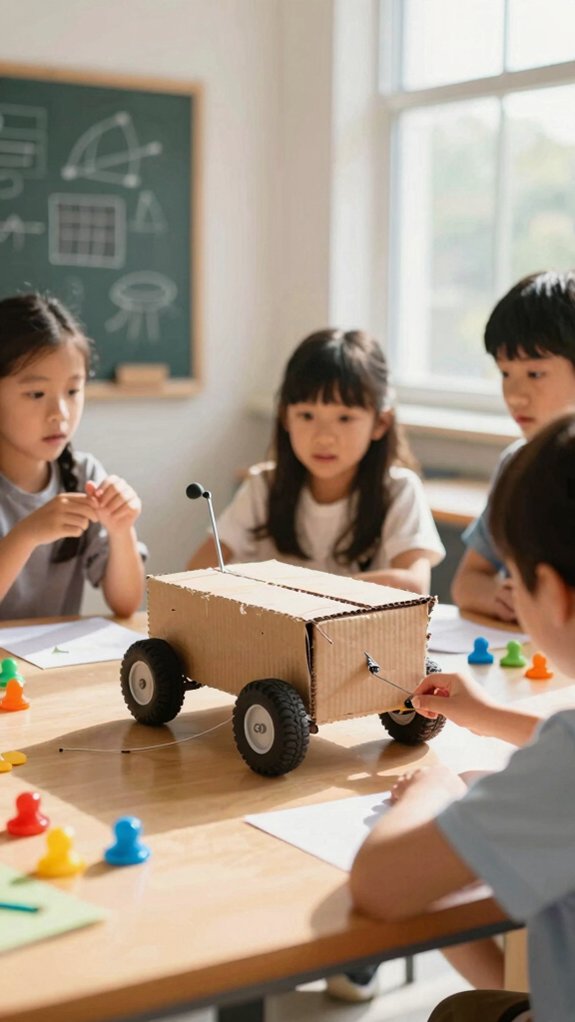
With a balloon-powered space rover, you can investigate how air can push a vehicle forward. Build a tiny frame, attach a balloon, and let balloon propulsion do the work. You’re part of a space team now.
| Test | What to Change |
|---|---|
| Distance | Add or remove weight |
| Direction | Shift the weight |
| Speed | Change balloon size |
| Stop time | Open or narrow airflow |
Use rough terrain simulation with books or tape lines. Give your rover mission goals, like reaching a zone or sample. After each run, record what changed. Then tweak it and try again. Soon, you’ll see how real rovers explore too.
Launch Paper Straw Rockets
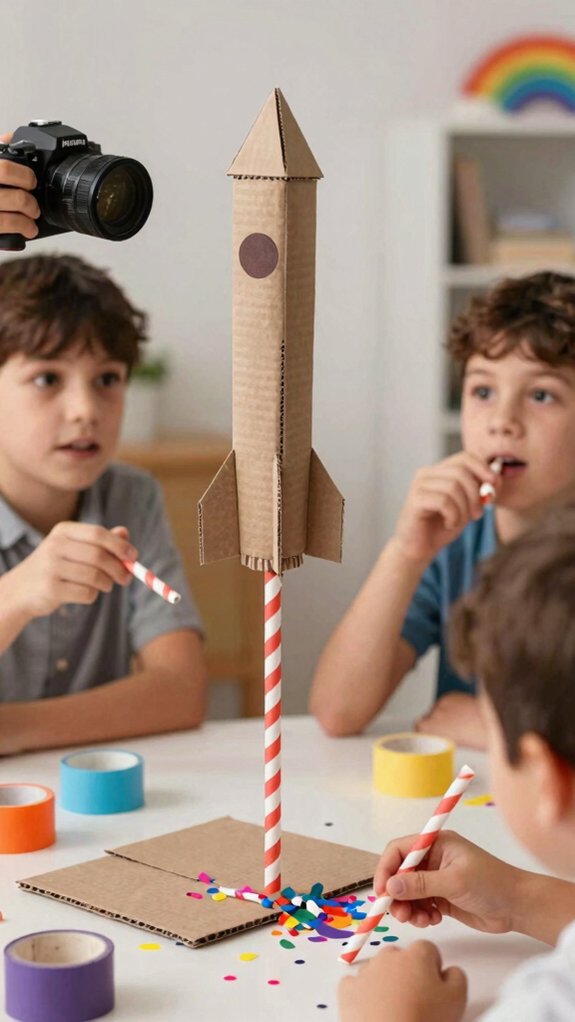
You can start by coloring and cutting out your paper straw rocket, then attach a thick straw body.
Next, you’ll build a simple launcher with a thin straw, so you can blow and watch it fly.
Each test helps you compare how air pressure changes speed, distance, and smooth flight.
Rocket Craft Materials
To start your rocket craft, gather a printable straw rocket shape, scissors, tape, and a paper straw. You’re joining a small space team, and your tools matter. Comet grab and asteroid labeling can make it extra fun.
- Cut the rocket shape neatly.
- Tape it to the paper straw.
- Make several rockets for fair testing.
- Try each one the same way and measure distance.
Use short indoor or backyard bursts. Record straw length, hole size, and how hard you blow. Small changes can shift flight. Compare speeds to orbit speed and note how a shuttle outruns a rifle bullet.
Building Straw Launchers
For your straw launcher, start by cutting and coloring a printable paper rocket template.
Attach a thick straw to the rocket’s back with mounting putty, and block the straw’s top so air stays inside.
Slide a thin straw into the thick one, then blow through it to send your rocket forward.
Keep the launcher steady so your rocket points straight.
Try different blowing strengths and Measure launch angles to see what changes.
You can compare flight paths and notice how far each rocket travels.
Some straw-rocket activities even connect to speeds near 18,000 miles per hour.
Repeat launches, and keep learning together.
Launching Flight Tests
Once your paper straw rocket is ready, it’s time for flight tests. You’ll join other young space explorers as you launch, watch, and learn.
Tape the rocket to your thick straw launcher, then blow through the thin straw. Try these steps:
- Compare real world propulsion with your tiny rocket blast.
- Change rocket mass effects by using a bigger or smaller rocket.
- Measure flight distances after each launch.
- Discuss airflow stability and see which setup flies straightest.
Make a Touchable Solar System
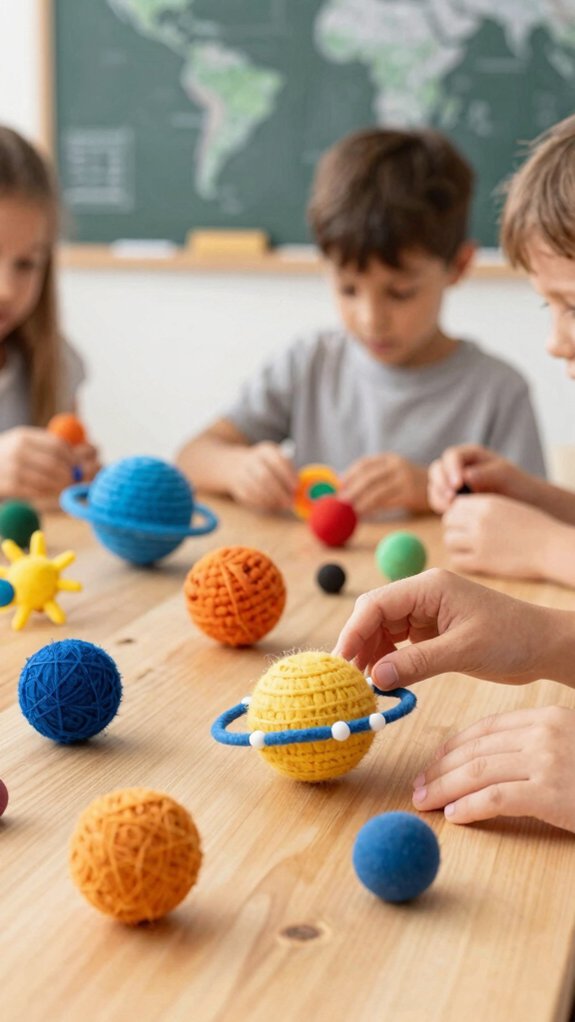
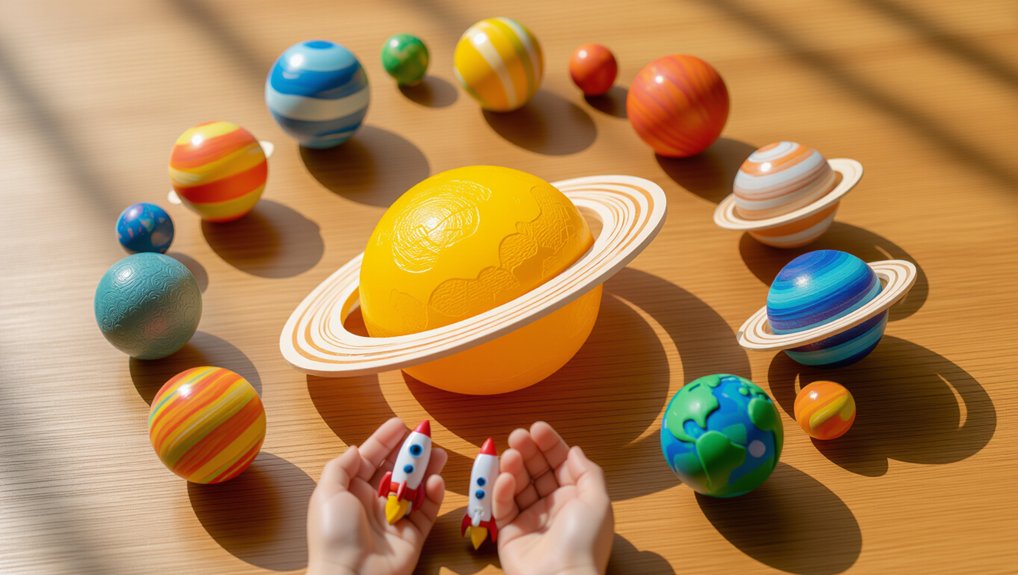
You can build a touchable solar system with planet balls or yarn-wrapped discs. As you sort them in order from Mercury to Neptune, you’ll feel how much the planets differ in size. Then you can move each planet along orbit paths and watch how they circle the Sun.
Build Textured Planet Models
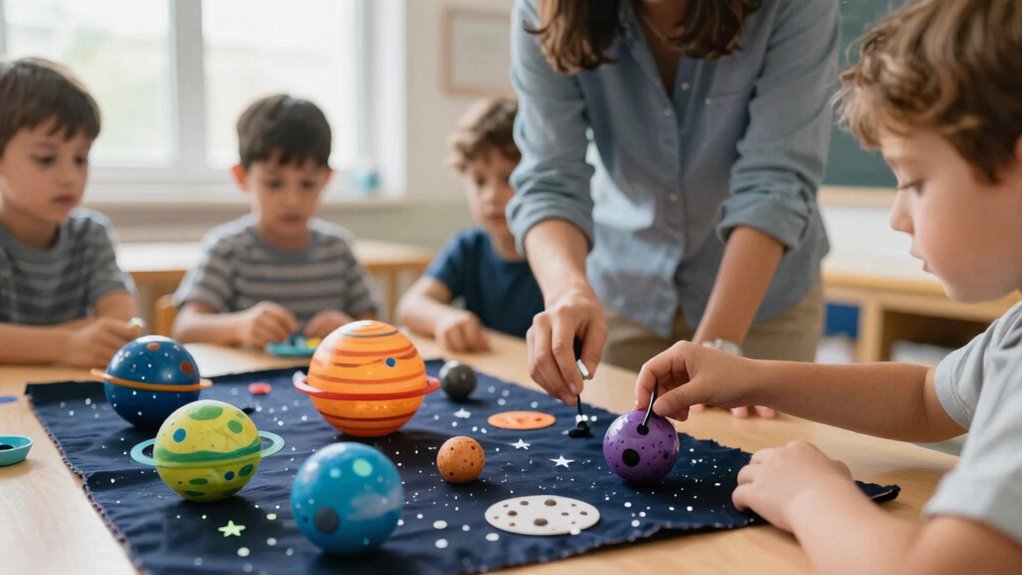
With a few simple materials, you can build a solar system kids can actually touch. Start with paper discs and wrap each one in colored yarn. Add pebbles, glitter, or fabric scraps for a textured finish. Keep sizes close to real life, like big Jupiter and small Mars.
Try this:
- Mercury with tiny dots
- Earth with smooth blue yarn
- Jupiter with thick yarn
- Saturn with ring-like scraps
Arrange them from Mercury to Neptune so hands can “read” the order. Use solar system riddles and planet matching games to make your crew feel included and ready to discover.
Explore Orbits With Touch
Now that you’ve built planets you can touch, let’s make them move. Use a large kitchen bowl to make a touchable orbit path. Roll a marble and watch how throw direction changes its landing.
Try a straw launcher with a rocket template to show curved motion and escape velocity.
Then use a tennis ball and marble support to feel how speed control and starting height change motion paths.
Build a spinning solar system with a paper plate and yarn planets. Touch and chart each trial.
You’ll learn orbit vocabulary by comparing smooth curves with steep falls together.
Try a Moon Crater Experiment
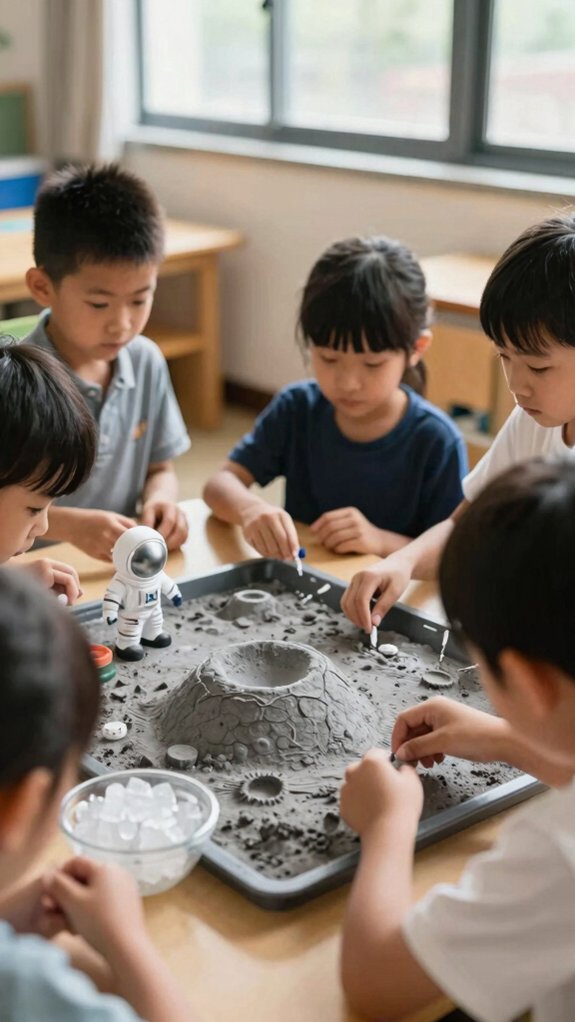
If you want to see how the Moon gets its craters, try this fun experiment. You’ll feel like a real space investigator. Use a tray, flour mix, and small rocks.
- Cover the tray with your Moon Surface mix.
- Sprinkle cocoa and bright bits for texture.
- Drop one rock from different heights.
- Measure each crater and record it.
When you raise the rock higher, its Impact Energy grows. That makes bigger, deeper craters. Talk with your group about what you notice. You’ll see how space rocks leave bowl-shaped marks on the Moon.
Create Yarn-Wrapped Planets
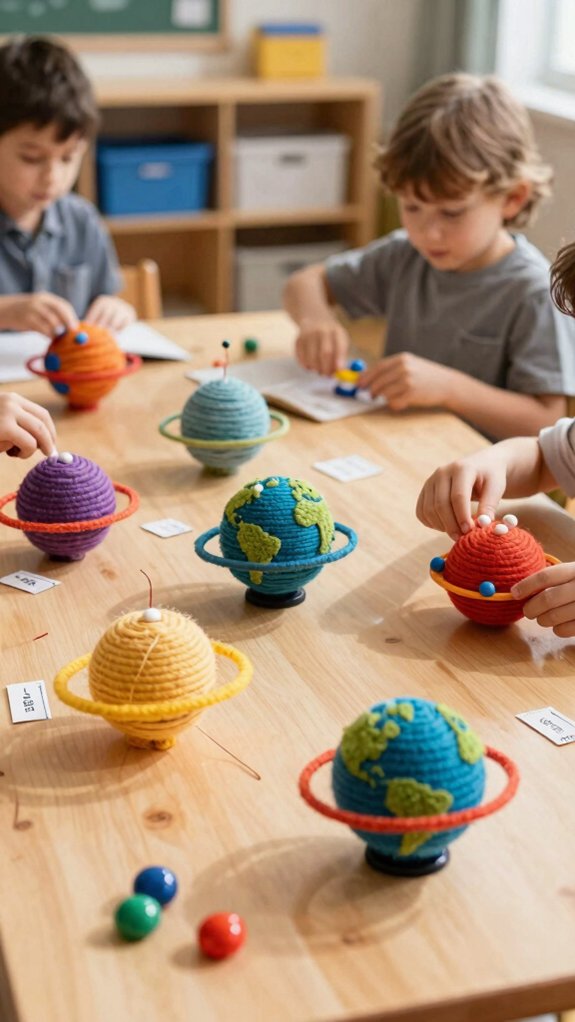
As you build your own yarn-wrapped planets, you can turn simple craft materials into a tiny solar system. Wrap cardboard discs with colored yarn, then add pebbles or paint for texture. Keep sizes relative, so Mercury stays small and Jupiter looks huge. This helps you practice planet sequencing and remember the order.
| Planet | Size idea |
|---|---|
| Mercury | tiny |
| Jupiter | extra large |
| Neptune | medium |
Add string or yarn orbit lines around your base. Finish with solar system labels for each planet card. You’ll build skills, confidence, and a space scene that feels like yours.
Play Planet Games
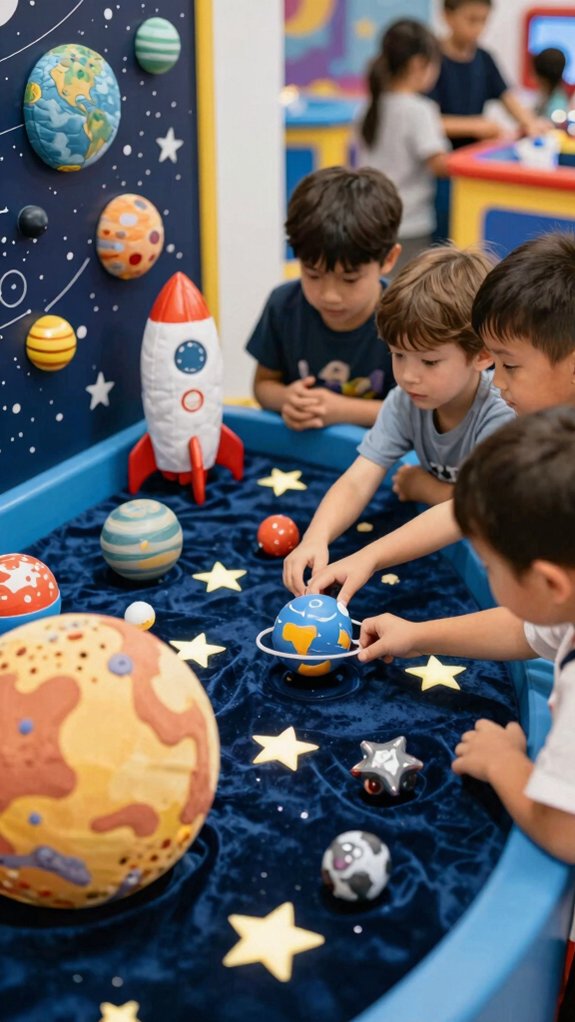
How can you turn planet facts into a game you’ll want to play again and again? You can gather friends and start quick planet challenges that feel like a team win.
Are planets different sizes? You’ll find out fast while you play and compare cards. Try these ideas:
- Match free printable cards to planet facts.
- Build a simple path game with a die and planet prompts.
- Tape cards on foreheads and guess together.
- Use SpacePlace-style mini-quizzes for speedy reviews.
Planet facts teamwork play keeps everyone involved, and you’ll keep learning with every round.
Map Constellations With Geoboards
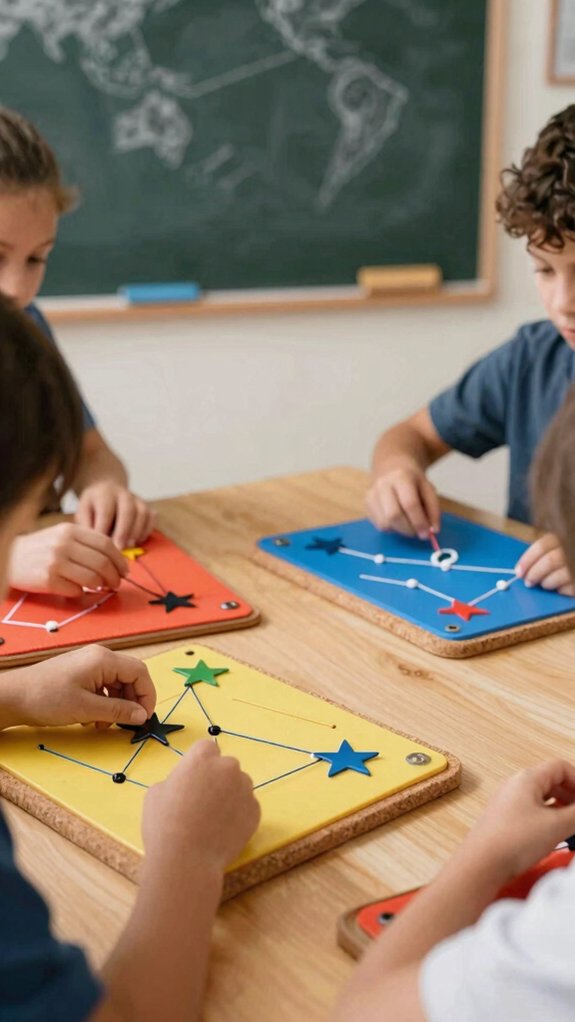
After planet games, you can look up and turn star patterns into a hands-on puzzle. Use a geoboard and rubber bands to build each constellation. Follow a printable guide, so you place every band in order. That helps you discuss star to star patterns, not just single stars. You can also Explain night sky orientation by naming where the shape sits on your grid.
| Constellation | Peg Count | Shape Clue |
|---|---|---|
| Orion | 7 | Belt center |
| Big Dipper | 8 | Curved handle |
| Cassiopeia | 5 | Zigzag line |
Build one at a time. Add labels, then check your map together.
Set Up a Space Sensory Bin
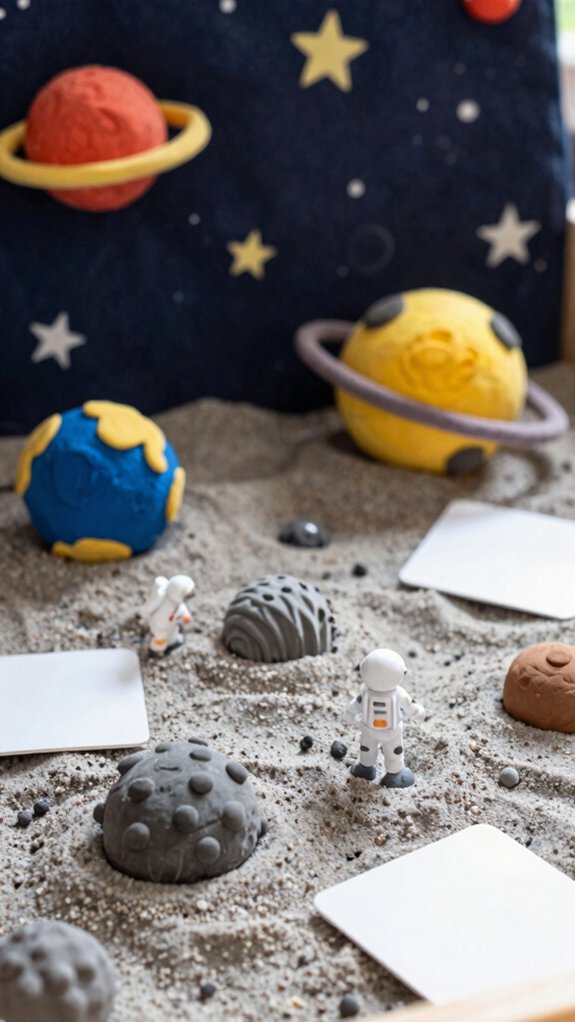
You can fill a space sensory bin with cake mix, small planets, and astronaut toys. As you stir, scoop, and pour, you’ll build fine-motor skills and investigate space in a hands-on way.
Keep using words like planet, moon, star, and galaxy so you learn while you play.
Space-Themed Fillers
In a space sensory bin, kids can dig, sort, and uncover with their hands. Start with cake mix for a soft, moon-dust feel. Add astronauts, planets, and rockets for texture vocabulary and planet sorting practice.
- Name each item aloud.
- Sort planets vs. spacecraft.
- Tell why it belongs in space.
- Share your favorite find.
You can also make a Galaxy-in-a-Jar with paint, cotton balls, glitter, and water. These fillers invite hands-on uncovering and build fine-motor skills.
When you finish, talk about what you found. That keeps everyone learning together.
Sensory Play Ideas
A space sensory bin can turn playtime into a tiny adventure. Use cake mix as the base, then add astronauts and planets for tactile exploration. Invite your kid to dig for a comet or moon rock. That makes sensory word play feel exciting and shared.
| What You Feel | What You Learn |
|---|---|
| Soft moon sand | Space vocabulary |
| Shiny foil balls | Tactile exploration |
| Swirled colors | Galaxy in a jar |
You can also make a galaxy in a jar with paint, cotton balls, glitter, and water. After play, name each find together and build belonging.
Vocabulary Through Exploration
With a space sensory bin, kids can discover new words with their hands. Fill it with moon-sand, tiny planets, stars, and astronaut figures. Add cotton balls for nebulae and glittery pieces for asteroids. You’ll build a fun place to learn together.
- Ask kids to label items while digging.
- Say, “Find the moon” or “Show me an asteroid.”
- Practice sorting objects by vocabulary, like planets and asteroids.
- Let them feel smooth gems for meteorites and fluffy cotton for clouds.
You’ll help kids connect words to touch. That makes space learning stick and feel like a team adventure.
Make a Galaxy in a Jar
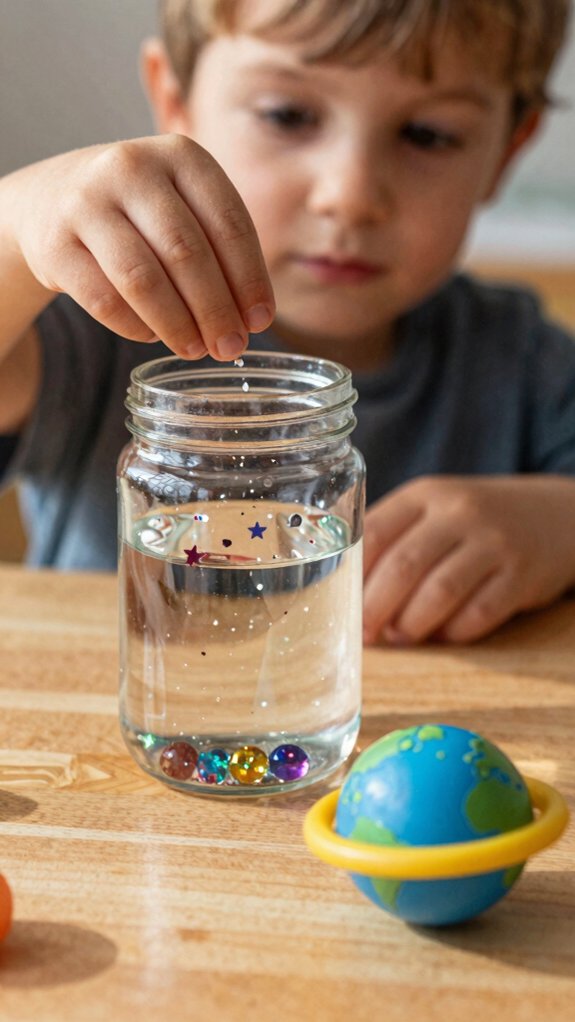
Turn a plain jar into a tiny universe that glows with color and motion. You’ll need a clear jar, a lid, tempera paint, cotton balls, glitter, and water.
Paint inside the jar with two colors, then add cotton balls for nebula clouds. Sprinkle glitter for distant stars.
Add water last, then seal the lid tightly. Gently swirl it and watch the galaxy move.
During quiet time, use your jar to observe cloud motion, spot galaxy colors, and talk constellations patterns. You’ll connect art and science while feeling part of something huge and amazing.
Craft an Astronaut Training Center
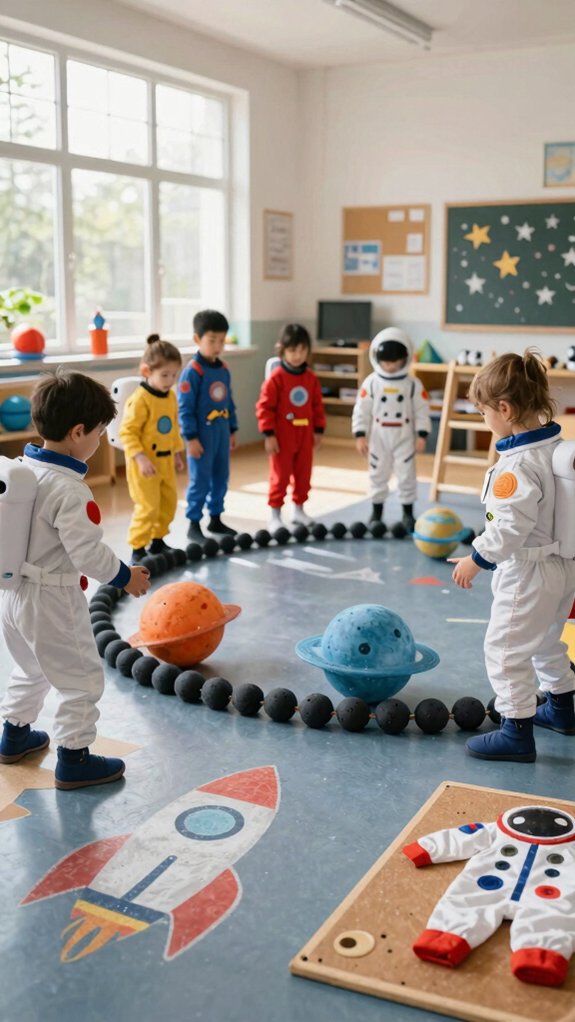
If you want to feel like a real space adventurer, build your own astronaut training center. You’ll join the crew and practice like investigators do.
Set up stations that make every mission feel real:
- Planet fact flash cards and astronaut vocabulary
- Planet roleplay with printable models and crayons
- A space schedule with clip-on training cards
- Mission journals for findings and a mini rover test
Add a solar-system build area so you can check planet order and size.
Use sentence starters like “I can,” “I have,” and “I am.”
Then share your findings with confidence and pride.
Turn Space Projects Into STEM Lessons
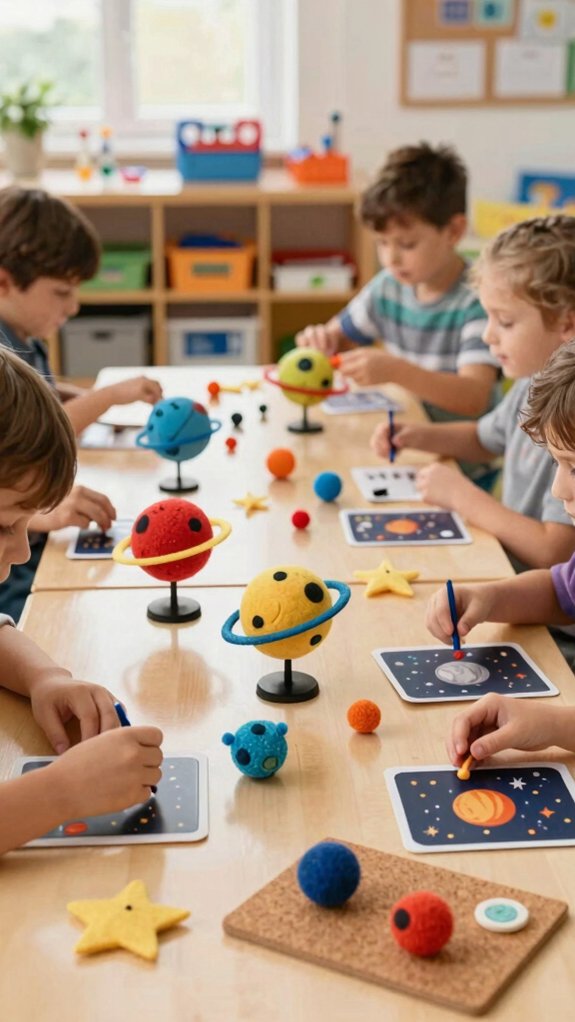
As you build space projects, you can also turn them into real STEM challenges.
Test your balloon rover by timing its trips and changing the wheels or payload.
Try straw rockets and see how straw thickness and airflow change distance.
Build a model solar system to practice mission planning and planet order.
Use bowls, marbles, or tennis balls to explore gravity and velocity by changing angle and speed.
Keep data tracking in a chart and write notes in science journaling.
These space tasks help you think like a real explorer and solve problems with your team.