
What Motion Really Means Beyond Speed and Movement

- What Motion Really Means Beyond Speed and Movement
- Key Takeaways
- What Motion Really Means
- Why Reference Frames Matter
- Motion in Physics and Astronomy
- Proper Motion Basics
- Measuring Stellar Drift
- Motion Across Space
- Proper Motion Across the Night Sky
- How Proper Motion Reveals Nearby Stars
- Nearby Stars Move Faster
- Measuring Angular Drift
- Hidden Neighbors Revealed
- Galileo’s Idea of Uniform Motion
- Uniformly Accelerated Motion
- Equal Increments Of Speed
- Falling Bodies And Time
- Free Fall and the Odd-Number Rule
- Motion in Classical Mechanics
- Motion in Relativity
- Motion at Quantum Scales
- Quantum Position Changes
- Probabilistic Motion Paths
- How Astronomers Measure Motion
- Why Motion Still Matters in Science
- Key Takeaways on Motion
Motion is more than speed or simply moving around. You see motion when something changes its position over time. That can mean a car rolling, a star drifting, or a ball falling faster each second. In science, motion also depends on your point of view. Different frames can change what you measure. So motion helps you study change, direction, and force, and there’s even more to uncover just ahead.
Key Takeaways
- Motion is any change in position, velocity, or state over time, not just fast movement.
- Whether something is moving depends on the reference frame used to compare it.
- In astronomy, motion is often tiny sky drift measured across images taken years apart.
- Proper motion is a vector on the sky, with direction and speed components, not a single number.
- In gravity and relativity, motion follows forces or spacetime geometry, which shape how it changes.
What Motion Really Means

When you hear the word motion, you might think only of speed or movement. But the Kinematics definition is broader: motion means a system changes over time.
You can spot this through position and velocity shifts. In astronomy, you notice tiny celestial drift by comparing images years apart. That helps you work within observational limits and measurement uncertainties.
Motion often needs vector decomposition, so you split it into parts like transverse motion.
Proper motion also shows reference dependence, and tiny angles can still matter. Even near inertial frames, you can track the sky’s quiet change.
Why Reference Frames Matter

Reference frames matter because motion only makes sense compared with something else. You see frame dependence when a star shows measurable drift in one setup but not another. Your coordinate geometry and astrometric conventions shape the result, including ICRF synchronization and a cosmological reference.
- Observer motion can change apparent motion.
- Velocity interpretation shifts with the chosen frame.
- A relativistic correction may improve your reading.
- Your path looks different in each frame.
When you compare positions over time, you join a shared view. That helps you trust the sky together.
Motion in Physics and Astronomy

In physics, you track motion by seeing how position changes over time.
In astronomy, you watch proper motion, which shows how a star drifts across the sky.
When you combine that drift with other clues, you can map motion through space.
Proper Motion Basics
Although stars seem fixed, their positions slowly shift across the sky. You can call this proper motion, the tiny angular drift you notice against distant space.
- It stays on the sky, not along your line of sight.
- Nearby stars often move more, like Barnard’s Star.
- Their motion links distance and sideways speed.
- Astronomers use annual parallax, distance correction, coordinate transformations, and astrometric calibration to keep shared maps fair.
You’ll see it in mu_alpha and mu_delta, which together make the total mu. Over years, common proper motion can show you belong to a real stellar family.
Measuring Stellar Drift
Now let’s see how astronomers actually catch a star’s tiny drift across the sky. You compare its position in images from different years, then measure the shift in arcseconds.
Good astrometric calibration keeps your data steady.
Careful time baseline selection helps tiny changes stand out.
You also watch for Parallax confusion, which can mimic drift if Earth’s view changes.
Image subtraction limits can hide faint shifts, so catalogs and reference stars matter too.
With enough time, you can track proper motion in milliarcseconds per year and feel part of the same sky-watching team that maps our galaxy.
Motion Across Space
When scientists talk about motion across space, they mean how an object’s position changes over time compared with a reference frame. You can think of it as a sky plane vector in celestial coordinates, not just speed.
- Proper motion shows a star’s tiny drift across the sky.
- You measure it in milliarcseconds per year.
- The rule μ = vₜ / d connects motion, distance, and sideways speed.
- Nearby stars like Barnard’s Star move more, so you can spot their change.
When you watch these shifts, you join astronomers in reading the sky’s quiet story.
Proper Motion Across the Night Sky

Have you ever noticed that stars don’t stay in exactly the same spots? That shift is called proper motion, and you can track it against fixed sky maps.
It’s a tiny angle on the sky, usually in arcseconds each year.
You may see astrometric errors, parallax confusion, instrumental drift, or bad calibration checks, so careful comparison matters.
Astronomers use old and new images, or blink methods, to spot change.
Proper motion has two parts, and the total can be written from both.
When you notice common motion in a group, you’re seeing a shared pattern in space.
How Proper Motion Reveals Nearby Stars
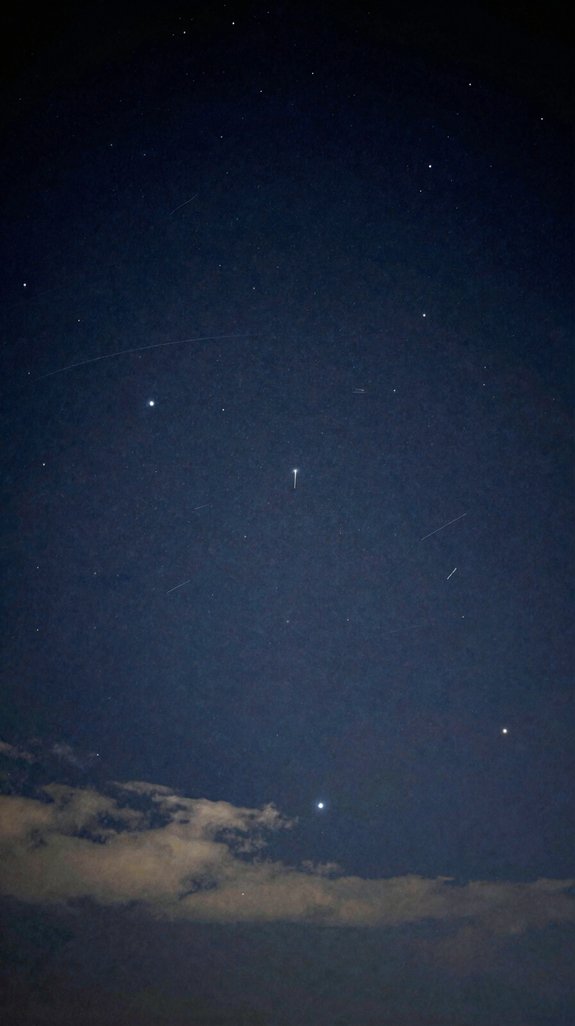
You can spot nearby stars because they seem to drift faster across the sky. Astronomers track that tiny angular motion over many years to measure proper motion.
When a star’s shift stands out, it may be one of our hidden neighbors.
Nearby Stars Move Faster
Nearby stars often seem to glide across the sky faster than faraway ones. That’s the Distance–velocity relation at work. When a star is close, its sideways speed makes a bigger shift on your sky. This isn’t just observational selection bias. You’re seeing real motion.
- Proper motion is a star’s tiny drift across the sky.
- Close stars like Barnard’s Star can look very fast.
- Distant stars usually seem slower because distance stretches the effect.
- Similar drift patterns can hint at stars traveling together.
Measuring Angular Drift
When astronomers want to spot a nearby star, they watch for tiny angular drift. You can think of proper motion as a star’s slow slide across the sky. Scientists measure it in arcseconds per year against a steady frame like the ICRF.
| Measure | Meaning |
|---|---|
| μRA | east-west drift |
| μDec | north-south drift |
| μ* | μRA cosδ |
| μ | total drift |
| d | distance from parallax |
You’ll see parallax corrections and calibration uncertainties matter. Multi-epoch images show the shift, and nearby stars often stand out. Barnard’s Star moves fast, while many stars barely creep.
Hidden Neighbors Revealed
How do astronomers find hidden stellar neighbors? You watch stars across baseline intervals and compare their centroid shifts. In a careful survey comparison, tiny motion pops out. That motion gives you a Galactic perspective on who lives close by.
Nearby stars usually move faster across the sky because distance matters.
- Big proper motion can point to a nearby star.
- Barnard’s Star shows how strong this clue can be.
- Shared vectors can reveal common motion groups.
- Blink methods help you spot what once hid.
With each image pair, you join the hunt and uncover neighbors.
Galileo’s Idea of Uniform Motion

Galileo gave motion a simple, strong rule. You can picture uniform motion as equal distances in equal times. That means your time intervals and distances line up in a steady pattern. When you compare motions, reference speed ratios help you see how fast each one is. | Idea | Meaning |
| — | — |
|---|---|
| Equal times | Equal distances |
| Faster motion | Less time for same distance |
| Ideal uniformity caveats | Real motion can wobble |
This is an ideal model, not everyday life. Galileo knew that, and you should too. It gives you a clean way to think before real bumps and starts show up.
Uniformly Accelerated Motion

When you study uniformly accelerated motion, you see equal increases in speed over equal time.
That means a falling body doesn’t stay at one speed; it keeps speeding up as time passes.
Galileo showed that if you keep dividing time, the motion still grows smoothly through every tiny step.
Equal Increments Of Speed
In uniformly accelerated motion, a moving body gains the same amount of speed in each equal stretch of time. You can picture velocity increments arriving in matching time slices. That means speed climbs by discrete speed steps, not random jumps.
- Each beat adds the same change.
- Continuous acceleration keeps the motion growing.
- No speed is held still for long.
- You and I can trust the pattern because it stays steady.
Galileo saw this in falling objects and stronger hits from higher drops. So you feel a clear rule: every moment adds the same extra speed.
Falling Bodies And Time
That same steady pattern helps explain falling bodies and the way time matters.
In Galileo’s view, you can imagine a dropped body growing faster with each tick of time.
Like interval beats on timekeeping clocks, equal time parts bring equal gains in speed.
After two beats, you get twice the speed; after three, three times.
It’s not about random motion.
It’s about free fall under the same conditions.
If you expect the body to keep its last speed, you’ll miss the larger distance.
Galileo also saw that deeper hits from higher drops show this growing speed clearly.
Free Fall and the Odd-Number Rule

As Galileo studied falling bodies, he noticed a strange pattern that made sense. In free fall, you start from rest, then gain equal speed steps in equal time intervals. That means your motion builds, not jumps. When you compare equal times, the distances grow like 1, 3, 5, and more.
- Each new slice adds more speed.
- The first drop feels small.
- The next drops go farther.
- Bigger impact depth shows greater speed.
You can feel the idea in tests with soft material. Deeper marks mean the fall lasted longer and grew stronger, and you belong with thinkers who trust careful patterns.
Motion in Classical Mechanics

Classical mechanics gives motion a clear job: it tracks how an object’s position changes over time. You can think of it as a shared rulebook for you, planets, and falling balls.
In an inertial frame, an object stays still or moves at constant speed unless a net force acts.
You use Force balance to check what pushes or pulls are present.
Newton’s second law says F = ma, so acceleration shows the effect of force.
Newton’s third law reminds you that motions come from partners.
It works best for slow, everyday motion in Euclidean space.
Motion in Relativity

When you zoom close to light speed, motion starts to mean more than just moving from place to place. In relativity, you and your friends can measure the same trip in different ways. Time can stretch. Length can shrink.
- Rapidity versus acceleration helps you track speed changes.
- Rapidity adds cleanly, unlike normal velocity.
- Lorentz transformations change how motion looks from each frame.
- Spacetime trajectory geometry shows motion as a path in spacetime.
In gravity, you follow geodesics, so motion can feel like the shape of space guiding you.
Motion at Quantum Scales

At tiny quantum scales, you don’t track a perfect path like a marble. You watch a particle’s position change through a cloud of probabilities instead.
That means motion can feel fuzzy, yet it still follows real rules.
Quantum Position Changes
Even though tiny particles don’t follow smooth paths, they still “move” in a quantum way. You belong in this strange world, where wavefunction evolution shapes what you can learn.
Instead of a neat track, you watch position chances shift over time. Measurement outcomes tell you where a particle might appear, not where it “was” in a classically simple sense.
- Uncertainty limits what you know.
- Position and momentum can’t both be exact.
- Motion can mean state changes.
- Even at absolute zero, quantum activity stays alive.
Probabilistic Motion Paths
Quantum paths don’t work like neat road maps, and that’s what makes them so fascinating. You don’t track a tiny particle with one fixed line. Instead, you use a wavefunction to see where it’s likely to appear.
That means quantum trajectories are probabilistic, not exact. Near an atom, the electron forms a cloud, not a tidy orbit.
Because of uncertainty, you can’t know position and momentum at once. So you read motion through measured patterns.
When you compare interference versus paths, you see that probabilities shape the story. You belong in this picture, exploring nature’s hidden dance.
How Astronomers Measure Motion

How do astronomers know a star is moving if it looks still? They compare images from different years and spot tiny shifts. With Parallax effects and careful catalog calibration, you can join that search too.
Astronomers measure proper motion in arcseconds or milliarcseconds each year against a fixed frame like the ICRF.
- They track motion across the sky.
- They split it into μ_α and μ_δ.
- They use μ = vₜ / d for sideways speed.
- They compare old and new surveys, even blink images.
You’re part of a big sky team, watching stars quietly drift.
Why Motion Still Matters in Science

Although motion can look tiny or hidden, it still helps scientists explain the universe. You see Frame Independence when the same object seems different from each viewpoint.
That’s why Motion Lawlessness in one frame can still follow clear rules in another. Even small drifts matter because Earth turns and travels fast enough to shape what you observe.
Scientists use proper motion, distance, and speed to uncover real travel in stars and galaxies. In relativity, Relativity Effects change how motion works near gravity and speed.
Measurement Uncertainty stays important, so careful watching keeps your science team strong and connected to truth.
Key Takeaways on Motion

Now that you know motion matters in science, let’s lock in the main ideas. You track motion by comparing it with a reference frame, not by guesswork.
- Proper motion is a sky shift, not simple speed.
- Most stars move less than 0.01 arcsec each year.
- Big proper motion often means an object is nearby.
- Pair proper motion with radial velocity to map space motion.
You can split motion into right ascension and declination, using the cos δ fix. That helps you feel part of the sky.
These clues also support distance work and tests for gravitational redshift effects and frame dragging signatures.