






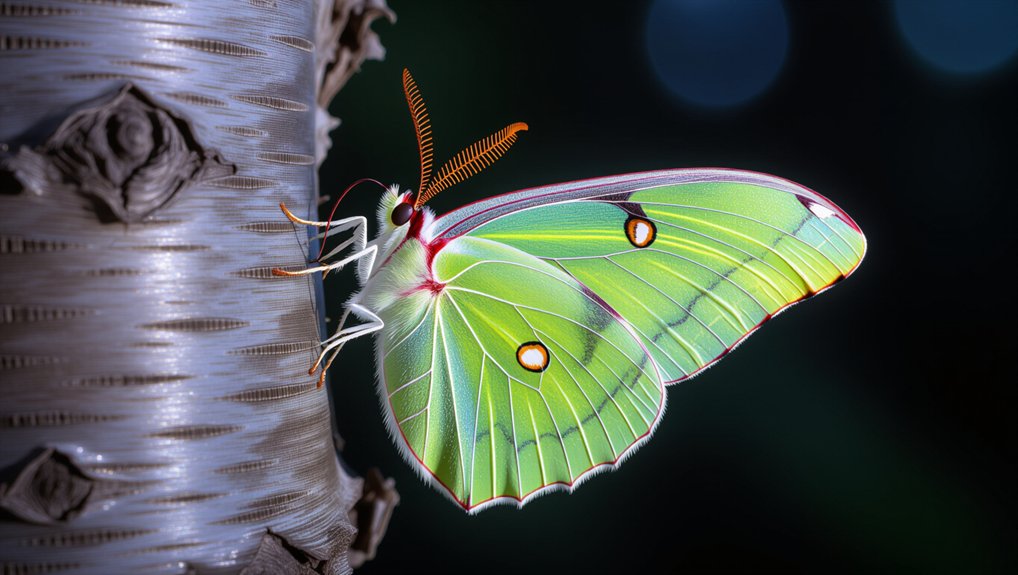

The luna moth is a large, bright green night moth with long tail streamers on its hind wings. It starts life as an egg then becomes a caterpillar, pupa, and short lived adult. Females lay many eggs and adults do not eat. Males have feathery antennae to find mates at night. Caterpillars eat tree leaves and help ecosystems. Light pollution and habitat loss threaten them. Keep exploring and more curious facts await.
- Key Takeaways
- What Is Luna Moth Actias Luna American Moon Moth
- Luna Moth Physical Description Color and Wingspan
- Geographic Range Luna Moth North America Distribution
- Luna Moth Habitat Deciduous Forests Woodlands
- Host Plants Luna Moth Caterpillar Food Trees
- Luna Moth Egg Stage Development and Incubation
- Caterpillar Development Five Instar Molting Stages
- Luna Moth Larva Defense Mechanisms Spines
- Pupation Luna Moth Cocoon Formation Process
- Diapause Dormancy Luna Moth Winter Survival
- Adult Luna Moth Emergence Wing Expansion
- Eyespots Luna Moth Defense Predator Confusion
- Hindwing Tails Luna Moth Bat Echolocation Defense
- Nocturnal Behavior Luna Moth Activity Patterns
- Mating Behavior Luna Moth Pheromone Communication
- Sexual Dimorphism Antennae Differences Between Sexes
- Lifespan Luna Moth Adult Life Duration
- Life Cycle Univoltine Bivoltine Trivoltine Generations
- Seasonal Variation Luna Moth Color By Generation
- Vestigial Mouthparts Luna Moth Non Feeding Adults
- Reproduction Egg Laying Luna Moth Females
- Environmental Factors Luna Moth Habitat Quality
- Conservation Status Luna Moth Population Trends
- Light Pollution Impact on Luna Moth
- Ecological Role Luna Moth Food Web
- Attracting Luna Moths to Your Garden
- Frequently Asked Questions
Key Takeaways
- Luna moths (Actias luna) are large, lime-green nocturnal moths with 4.5–7-inch wingspans and long, curved hindwing tails.
- Their life cycle includes egg, five caterpillar instars, silk cocoon pupation, and a nonfeeding adult stage lasting about one week.
- Males have bushy, feathered antennae to detect female pheromones; females have fuller abdomens for carrying 200–400 eggs.
- Caterpillars feed on trees like walnut, hickory, sweetgum, and birch, then pupate and may diapause through winter.
- Light pollution and habitat loss reduce mating success and populations; planting host trees and reducing night lights helps conservation.
What Is Luna Moth Actias Luna American Moon Moth
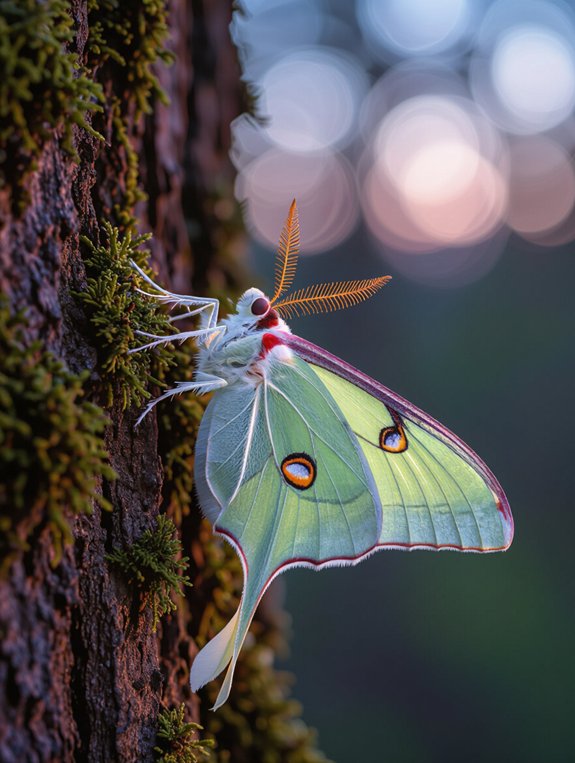
A luna moth is a large and beautiful night insect found across North America. It is called Actias luna and people also name it the American moon moth. This moth lives mostly at night and appears in spring and summer. Its life includes egg, caterpillar, pupa, and adult stages. Adults do not eat and live briefly to mate and lay eggs. Communities often see it as a sign of change and hope. Luna moth symbolism and Luna moth mythology tie it to the moon and new beginnings. The moth invites belonging and wonder for curious learners.
Luna Moth Physical Description Color and Wingspan
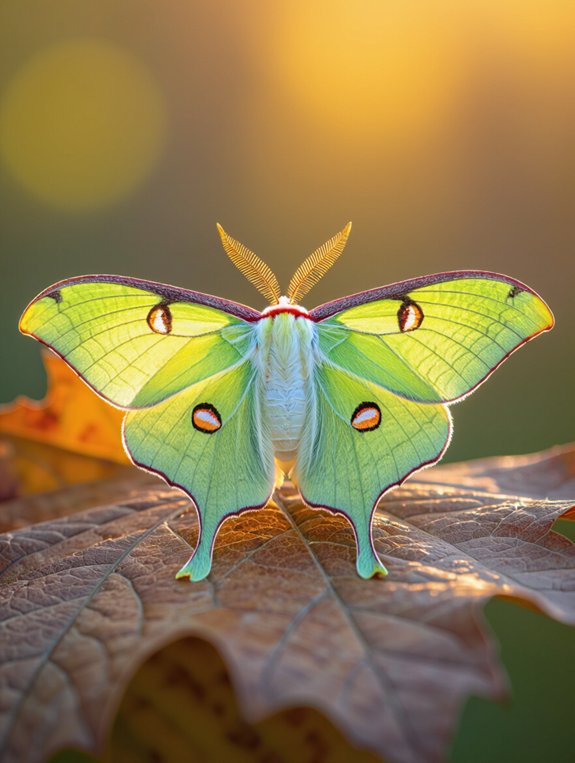
After learning about its life cycle and night habits, attention turns to how it looks. The luna moth shows bright lime green wings that help it hide in leaves. Observers note clear luna moth coloration patterns that guide recognition. The wingspan ranges from 4.5 to 7 inches, making it large and impressive. Its luna moth wing morphology includes long curved tails on the hind wings. Each wing has a single transparent eyespot that can trick predators. Males and females share green wings. Females have a fuller abdomen than males, which supports eggs and future generations.
- Lime green wing color blends with foliage
- Wingspan 4.5–7 inches, significantly large
- Long curved hind wing tails confuse predators
- One transparent eyespot per wing for defense
- Females have larger abdomens for egg carrying
Geographic Range Luna Moth North America Distribution
Although best known in eastern forests, the luna moth lives across much of North America. It ranges from Florida to Maine and into central Canada. Records show it from Saskatchewan through Quebec to Nova Scotia. These patterns reflect clear range preferences for areas with suitable host trees. Some moths appear as rare vagrants in Western Europe, but they do not establish there. Population fluctuations change by region. In warmer areas the moth can have more generations each year. In cooler zones it usually has one. This variation helps communities of people feel connected to local seasonal changes.
Luna Moth Habitat Deciduous Forests Woodlands
Many luna moths live in deciduous woodlands where their caterpillars find food and shelter. The moth prefers moist forests with plenty of host trees and shaded areas. It ranges across eastern North America and uses trees for life stages. Habitat loss and light pollution threaten local groups. Community actions help protect these places. Deciduous forest conservation and habitat restoration are key goals. People can join projects and feel part of a caring group.
- Learn about local woods and species.
- Support native tree planting.
- Reduce outdoor light at night.
- Join habitat restoration events.
- Share sightings with neighbors.
Host Plants Luna Moth Caterpillar Food Trees
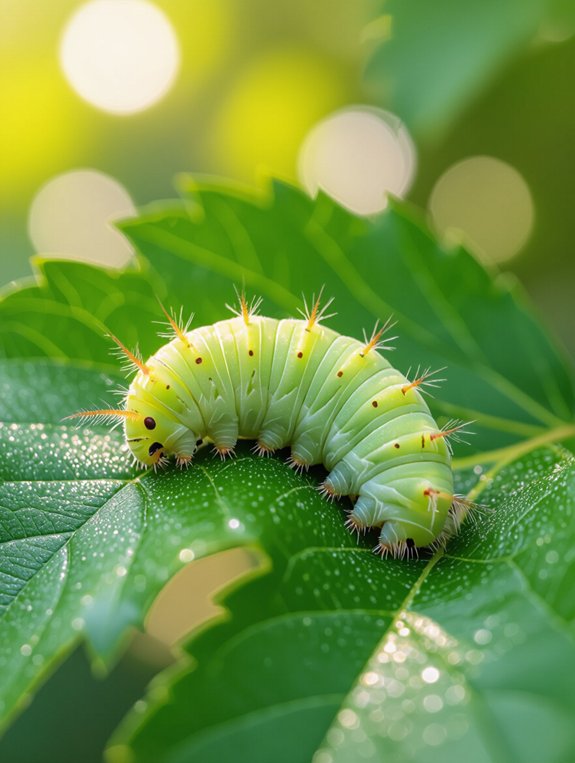
Leaves are the main food for luna moth caterpillars and they eat a few kinds of trees. The caterpillar diet centers on broadleaf species like walnut, hickory, sweet gum, and paper birch. Young readers can picture hungry caterpillars munching for about a month. They grow large before spinning a cocoon. Choice of tree matters. Host tree selection depends on local availability and leaf quality. Experiments show some trees give poor survival. This shows luna moths specialize on certain plants in their homes. Knowing this helps friends protect the right trees for these gentle forest visitors.
Luna Moth Egg Stage Development and Incubation
After finishing their feeding on trees, luna moths begin the egg stage of their life. Females start egg laying on the underside of host leaves like walnut and hickory. Eggs are tiny, about 1.5 mm, mottled white and brown. The incubation period lasts about 8 to 13 days. Many eggs are laid, often 200 to 400, to give the group a better chance. Successful hatching is essential because larvae need specific food to grow. This stage ties families of observers together as they watch nature carefully and patiently.
- Eggs measure roughly 1.5 mm across
- Laid under leaves for protection
- Incubation period: 8–13 days
- Females lay 200–400 eggs
- Hatching leads to immediate feeding
Caterpillar Development Five Instar Molting Stages
Although small at first, luna moth caterpillars grow a lot through five clear stages called instars. Each instar shows visible caterpillar growth as the body widens and new markings appear. They eat leaves from trees like hickory, walnut, birch, sweet gum, and persimmon to fuel this change. Instar duration is short, usually several days, before a molt occurs. After the fifth instar they spin silk and form a cocoon to pupate. The pupation lasts about two to three weeks. The group can watch and learn, sharing wonder about this careful, steady transformation together.

Luna Moth Larva Defense Mechanisms Spines
As the caterpillar grows through its last instars it also gains a new kind of protection. The luna moth larva forms short sharp spines along its body. Spine development happens mostly in late instars. These spines create a physical barrier against birds and insects. They do not rely on chemicals. Instead they help predator evasion by making the caterpillar harder to bite. This change boosts survival as the caterpillar prepares for the next stage. Readers who care for nature can feel connected to this small, brave creature.
- Spines appear stronger in late instars
- Physical barrier, not chemical
- Less palatable to predators
- Helps avoid quick attacks
- Shows evolutionary strategy
Pupation Luna Moth Cocoon Formation Process
The caterpillar spins a snug silk cocoon to begin pupation and stay safe. It weaves silk among leaf litter where color and texture help it blend. This choice adds cocoon protection from predators and weather. Inside, the larva transforms slowly. The pupation duration lasts about two to three weeks as tissues reorganize into adult parts. The cocoon keeps the developing moth hidden and cushioned during change. When metamorphosis finishes, the adult chews its way out and unfolds wings. Readers who care about nature can feel connected to this quiet, brave stage of the luna moth life cycle.
Diapause Dormancy Luna Moth Winter Survival
How do luna moths survive long, cold winters inside their cocoons? Autumn-born larvae enter diapause mechanisms and become dormant in silk cocoons. They slow metabolism and resist cold. This winter strategies choice times emergence with spring food. Dormancy may last months until warm cues arrive. Adults then emerge to find fresh host leaves. This modification helps the species and welcomes a new generation in the community.
- Diapause lets development pause through cold months.
- Metabolic slowdown preserves energy.
- Cocoon offers physical shelter.
- Timing matches host plant growth.
- Emergence follows warming cues in spring.
Adult Luna Moth Emergence Wing Expansion
When a luna moth finally pushes out of its cocoon, it must rest and expand its wings before flying. The moth uses wing mechanics that pump hemolymph into veins to unfold and harden wing surfaces. This step is slow and careful. Emergence timing matters because the moth prepares at dusk to fly at night. Wings reach up to seven inches across when fully open. The bright lime color appears as wings dry. Energy from the caterpillar stage fuels this effort since adults do not eat. Friends who watch can feel part of this quiet moment of growth and wonder.
Eyespots Luna Moth Defense Predator Confusion
Although it looks fragile, the luna moth uses clever tricks to avoid predators like bats. The wings show a single clear eyespot on each side. These spots mimic larger eyes and cause hesitation. Placement draws attacks away from the moth’s body. This is part of eyesport evolution and predator avoidance together. The moth also uses flight moves for extra confusion. These tricks help it survive in forests. Readers can feel connected to nature by learning this. Simple design leads to big protection. Small details matter and show how species work as part of a shared world.
- Eyespots mimic eyes to scare predators
- Spots placed to mislead attack focus
- Visual trick plus flight increases safety
- Acts of evolution favor clever defenses
- Observing them builds a sense of belonging
Hindwing Tails Luna Moth Bat Echolocation Defense
A striking feature of the luna moth is the long tails on its hindwings that help it survive bat attacks. The tails serve hindwing functionality by confusing predators. They can spin and flutter to make a moving target away from the moth body. This motion disturbs bat echolocation and makes strikes less accurate. As a result moths escape more often during bat predation attempts. The tails work with flight moves to increase survival. Readers who care about nature can feel part of a group that values smart adjustments. Simple studies show these traits help luna moths live longer.
Nocturnal Behavior Luna Moth Activity Patterns
Because luna moths are night flyers, their lives follow a quiet daily rhythm. They wake at dusk and glide under moonlight. Night activity helps them avoid birds and daytime danger. Adults live about a week and do not eat. They depend on stored energy from caterpillars. Warm months bring their highest flights. Their green wings stand out in soft light. Nocturnal navigation guides them through trees and fields. Pheromone signaling helps long-distance contact without bright displays. This steady life feels like a shared secret among night creatures. It invites readers to care and feel connected to the dark.
- Active after dusk
- Peak in late spring and summer
- Short adult lifespan
- Rely on stored energy
- Use scent and moonlit cues
Mating Behavior Luna Moth Pheromone Communication
When night falls, female luna moths send out a special scent that calls males from far away. The scent is a species-specific pheromone named E6, Z11-18:Ald. Pheromone analysis shows it travels miles and guides males to females. Mating signals begin after midnight. Females often mate with the first males that arrive. This system boosts mating success during a short adult life. After mating females lay 200 to 400 eggs on host trees. The community of readers can feel connected to this natural teamwork. It shows cooperation in nature and invites gentle wonder.
| Feature | Purpose |
|---|---|
| E6, Z11-18:Ald | Species signal |
| Night release | Long range |
| Timing | After midnight |
| Eggs | 200–400 |
Sexual Dimorphism Antennae Differences Between Sexes
Though they share the same bright wings, male and female luna moths show clear differences in their antennae. Males have bushy, broad antennae that boost antennae function by catching tiny pheromone molecules. Females have slimmer, less feathery antennae and play a different role in mating. This visible contrast is sexual selection at work and shows how form fits role. The differences help each sex succeed in shared community life. Readers who care about nature and belonging can see how each moth contributes to the pair bond.
- Male antennae catch faint pheromones from far away
- Broader surface raises sensitivity and range
- Female antennae reflect less searching role
- Shape differences are sexual dimorphism examples
- Antennae link to mating roles and teamwork
Lifespan Luna Moth Adult Life Duration
How long does a luna moth live as an adult? The adult lifespan is very short, about one week after emerging. It does not eat because it lacks a working mouth. Adults rely on energy saved from the caterpillar stage. The main job in this time is mating and laying eggs. Mating behavior happens mostly at night. Females release pheromones shortly after midnight to attract males. After mating adults quickly use up their energy. Females may lay 200 to 400 eggs before dying. Knowing this can help readers feel connected to these fragile, purposeful insects.
Life Cycle Univoltine Bivoltine Trivoltine Generations
Because climate and location change their timing, luna moths may have one, two, or three generations each year. The life cycle shifts with region. In Canada they are univoltine. In mid-Atlantic states they can be bivoltine. In southern areas they may be trivoltine. Eggs hatch in 8 to 13 days. Larvae pass five instars over six to seven weeks. Pupation lasts about two to three weeks in a silken cocoon. Adults live about one week to mate and lay eggs. Females lay 200 to 400 eggs on host trees, ensuring future generations and community of learners.
- Regions affect generation variations
- Egg incubation time
- Larval instars duration
- Pupation period
- Adult lifespan and reproduction
Seasonal Variation Luna Moth Color By Generation
When luna moths live in different places, their wing color can change from one generation to the next. The seasonal color shifts show how moths adjust. Northern generations often display blue-green wings. Southern generations lean toward yellow-green tones. These regional differences help moths blend with local trees and hide from predators. Environmental factors and host trees guide color change. Each generation shares this skill across North America. The pattern builds community knowledge among observers. It invites people to notice and care for habitats that support many generations of luna moths.
| Region | Typical Hue | Function |
|---|---|---|
| North | Blue-green | Camouflage |
| South | Yellow-green | Camouflage |
| Mixed | Varies | Adjustment |
Vestigial Mouthparts Luna Moth Non Feeding Adults
Although adult luna moths look ready to eat, their mouthparts are tiny and useless. They are vestigial modifications that prevent feeding in adulthood. Energy comes from stores built as caterpillars. Adults live about a week and focus on finding mates. This choice shows evolutionary significance: tradeoffs favor reproduction over long life. The moths belong to a cycle that values timing and success. Readers who care about nature can relate to this focused life stage.
- Adults cannot feed due to tiny mouthparts
- Energy stored in larval stage fuels adults
- Short lifespan emphasizes mating
- Evolution favors reproduction over longevity
- Unique trait among moths
Reproduction Egg Laying Luna Moth Females
After a brief adult life spent on finding mates, female luna moths turn to the task of laying eggs. She lays 200 to 400 eggs on leaves of host trees like walnut and hickory. The eggs are small, mottled white and brown, and about 1.5 mm wide. Incubation lasts roughly 8 to 13 days before larvae hatch and start feeding. Mating behavior often happens near midnight when females release pheromones to call males. In northern regions there is one generation a year. Southern populations may have two or three cycles annually, broadening their local community.
Environmental Factors Luna Moth Habitat Quality
Because luna moths need certain trees, good habitat matters for their survival and growth. The moth relies on walnut, hickory, persimmon, and sweet gum for caterpillar food. Habitat quality shapes growth and reproduction. Habitat preservation helps keep these trees and safe spaces. Light pollution at night can stop moths from finding mates. Communities can join monitoring and care efforts to protect woodlands. Small actions matter and welcome people into shared stewardship.
- Learn host tree names and plant where possible.
- Reduce outdoor lights at night.
- Support local habitat preservation groups.
- Help with moth monitoring.
- Share knowledge with neighbors.
Conservation Status Luna Moth Population Trends
Good habitat helps luna moths survive, but scientists also watch their numbers to see how populations are doing. The luna moth is common across the United States, yet declines occur in some states. Habitat destruction in deciduous woodlands is a leading problem. Conservation challenges include protecting breeding areas and growing public support. Increased artificial lights at night also harm mating and numbers. Population monitoring programs track changes and spot trouble early. When data show declines, communities can act. Local efforts to protect trees and share knowledge help the moth and connect people who care about nature.
Light Pollution Impact on Luna Moth
How does light at night change luna moth behavior and survival? Artificial lights confuse luna moths that use moonlight to navigate. They fly toward bright lights and leave safe habitats. This raises predator risk and lowers mating chances during their one-week adult life. Light can also mask female pheromones so males cannot find them. Protecting luna moths needs light pollution solutions and community action for luna moth conservation.
- Reduce outdoor lighting near woods
- Use shielded fixtures and lower brightness
- Choose amber or red bulbs over white
- Turn off unnecessary lights at night
- Support local dark sky initiatives
Ecological Role Luna Moth Food Web
A luna moth fits into its food web in several important ways that keep forests healthy. It eats tree leaves as a caterpillar and feeds birds and insectivores. Adults help pollinate briefly. These roles support predator prey interactions and overall ecological balance. Their tails help avoid bats and shape predator behavior. Loss of habitat weakens these links and can leave neighbors worried. The community can protect trees and night habitat to help them belong in the forest.
| Stage | Role | Effect |
|---|---|---|
| Caterpillar | Herbivore | Feeds on leaves |
| Caterpillar | Prey | Feeds birds |
| Adult | Pollinator | Aids plants |
Attracting Luna Moths to Your Garden
When gardeners want to welcome luna moths, they can create simple changes that make a yard more inviting. The focus is on luna moth gardening that helps life stages thrive. Plant host trees like walnut, hickory, sweet gum, and paper birch. Keep night lights low so moths use natural cues. Add broadleaf plants for food and shelter. Leave a quiet, undisturbed patch for cocoons. Use pheromone traps to monitor during late spring and early summer. These steps help attract moths and build community. Small acts connect people, plants, and nocturnal visitors.
- Plant host trees and broadleaf shrubs
- Reduce artificial night lighting
- Preserve a natural undisturbed area
- Use pheromone traps to monitor adults
- Offer diverse plants for shelter and food
Frequently Asked Questions
Do Luna Moths Migrate Long Distances Between Seasons?
No, Luna moths do not migrate long distances between seasons; Luna moths have limited migration patterns, remaining local and tied to host trees, yet communities of observers feel connected by shared appreciation for these fleeting, delicate visitors.
Can Luna Moths Be Bred in Captivity by Amateurs?
Yes, they can; enthusiasts practice breeding techniques and captive care to rear luna moths successfully. The community shares guidance, resources, and supportive mentorship so newcomers feel welcomed while learning host-plant rearing, pupation handling, and safe release practices.
Do Luna Moths Carry Parasites or Diseases Transmissible to Pets?
No — luna moths rarely pose parasite transmission risks to pets. Picture a delicate wing brushing air; hosts remain amphibian- and mammal-safe. Communities who care for wildlife share this cautious, inclusive pet health perspective.
Can Luna Moths Be Legally Collected or Kept in All States?
No — Luna moths cannot be legally collected or kept in all states. Community-minded guidance notes varying legal regulations; Luna moths protections and conservation efforts differ regionally, encouraging respectful local compliance and shared stewardship.
Are Luna Moths Affected by Pesticides on Ornamental Trees?
Yes; they are vulnerable to pesticide impact. Observers note ornamental tree effects reduce larval survival and adult emergence. Community members concerned about local biodiversity often support pesticide reduction to protect these shared, fragile moth populations.